Nexus IA
Nexus IA — Centralized artificial intelligence
- 5
- Nexus models
- 3
- AI providers
- 4.7s
- Average response time
Client
ExpoStacker
Sector
Artificial intelligence and productivity
Timeline
3 semanas · 2026-08
Live product
Use nowResults
Client-reported results during rollout
Baseline: 11/25 before event loop fix
Fonte: NEXUS audit
Baseline: without asset cache (estimated)
Fonte: Local test
Baseline: adaptable layout from 320px to 1200px
Fonte: CSS audit
Client-reported data
The challenge
The challenge
Nexus IA is an artificial intelligence SaaS that centralizes multiple models in a commercial dashboard. The platform offers five model profiles, context-aware chat, code generation and execution, workspace with terminal and an agent capable of creating files and editing projects.
Equipes e profissionais desperdiçam tempo alternando entre múltiplas ferramentas de IA, corrigindo respostas com acentuação quebrada e lidando com limites de uso de APIs individuais, o que reduz produtividade e aumenta custos operacionais.
The approach
The approach
We started from a simple dashboard and evolved into an architecture with latency-based routing, key pools per provider, persistent cache and automatic fallback. The front-end keeps the ExpoStacker visual identity with mobile responsiveness and accessibility.
The solution
The solution
- Dashboard with five Nexus models and automatic task-based routing
- Code assistant with generation, explanation and review
- Workspace with agent chat, terminal and quick actions
- URL research with context for page-based answers
- User plan, limit and cost control
- Commercial landing with SEO, schema.org, sitemap and robots.txt
Timeline
Como o projeto foi conduzido, do mapeamento ao deploy. How the project was conducted, from mapping to deploy.
Semana 1
Descoberta
- AI provider and key mapping
- Definition of Nexus models and personas
- Routing and cache architecture
Semana 2
Construção
- FastAPI with chat, code, crawl and agent
- Commercial dashboard with landing and plans
- Vite workspace with login and authentication
Semana 3
Validação
- Tests of all models and prompts
- SEO, sitemap and responsiveness audit
- Encoding and provider fallback adjustments
Methodology
Como o projeto foi conduzido, do mapeamento ao deploy. How the project was conducted, from mapping to deploy.
Continuous refinement sessions
Load and latency tests per model
SEO and accessibility audit
ExpoStacker component standards
Architecture
- → FastAPI orchestrates chat, code, crawl and agent
- → Router picks provider based on latency and quota
- → Round-robin key pool per provider
- → Persistent prompt and response cache
- → React Vite consumes the API via /api prefix
Conceptual diagram — does not reflect real implementation
Tech stack
Technical choices and what was left out.
Backend
Why: Async Python for external APIs
Rejected alternative: Django (heavier)
Why: Local database without external infrastructure
Rejected alternative: Postgres (future scale)
Why: Async client for external calls
Rejected alternative: requests (synchronous, blocking)
Frontend
Why: Fast SPA for the workspace
Rejected alternative: Next.js (overkill for MVP)
Why: Tokens consistent with ExpoStacker
Rejected alternative: Plain CSS (slower to prototype)
AI
Why: Low latency and competitive cost
Rejected alternative: OpenAI (higher cost)
Why: Large models without local infrastructure
Rejected alternative: Local Ollama (excluded by scope)
Why: Fallback with excellent Portuguese
Rejected alternative: Claude (no key in project)
Decision log
What I chose, what I rejected, and why.
Use provider routing with fallback
Why: Prevents failures due to unavailability or quota of a single external provider.
Rejected alternatives: Single provider simplifies code but creates a single point of failure.
MVP with SQLite instead of Postgres
Why: SQLite removes external database dependency and speeds up initial deploy.
Rejected alternatives: Postgres offers more scale, but requires extra infrastructure setup.
Dashboard in vanilla HTML/CSS + React Vite for workspace
Why: Fast and light landing; complex interactive workspace as React SPA.
Rejected alternatives: Everything in React would increase landing bundle and hurt SEO.
FASSI.AI
Intelligent routing pipeline
User sends the message
Classifier identifies the task
Router picks the best Nexus model
System tries providers by score order
Response is cached and recorded for cost
Engagement mechanics
Progressive plans
Free, Starter, Pro and Business unlock models and limits based on usage.
Active workspace
Projects and files keep the user returning to the environment.
Models per task
Nexus Auto, Fast, Standard, Advanced and Code teach the user to pick the right tool.
Security and access
Security and compliance
-
External API keys never exposed in the front-end
-
JWT authentication with secure cookies
-
Rate limit per route and per plan
-
CORS restricted to allowed domains
-
Dev environment flagged for future hardening
Lessons learned
Not everything went as planned.
— Sharing global async HTTP clients between synchronous requests causes event loop errors. Creating httpx clients per request solved timeouts and external provider encoding issues.
See also other products
 SEEDS Experience
 SEEDS Experience
Comunidade exclusiva de mulheres empreendedoras onde a membro entra, conecta-se e acessa oportunidades de capital e mentoria via IA.
View case → Frotamais
 Gerenciador Inteligente de Frotas
Produto de gestão de frotas ao vivo. Gestor vê veículos, rotas, manutenção e alertas no mapa.
View case →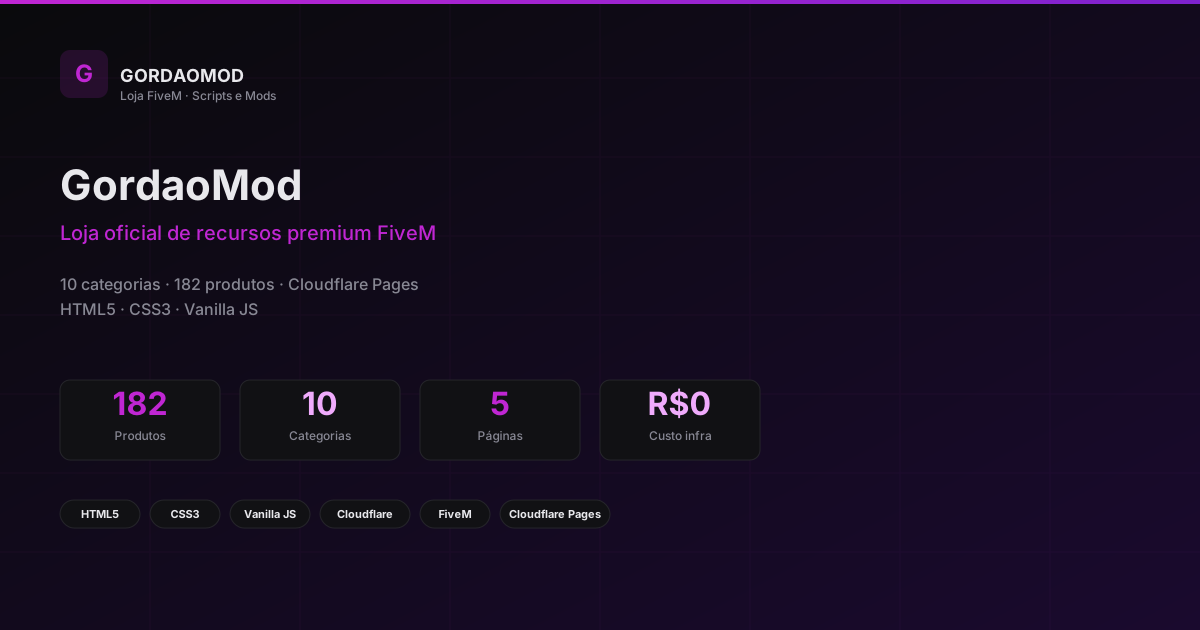 GordaoMod
 GordaoMod
Loja digital de recursos premium para FiveM. Dono de servidor encontra 182 produtos em 10 categorias e baixa o que precisa.
View case →Want a product like this?
I can do the same for your business. Let's talk.